Dearborn Electronics, Inc.
| EQUIVALENT SERIES RESISTANCE Low equivalent series resistance (ESR) is a most desirable characteristic for capacitors used for high-frequency/high-current a-c applications. Heat generated during a-c operation is directly related to capacitor ESR. While the dielectric loss for polypropylene is very low, the electrode resistance contributes significantly to the effective ESR, and must be considered in optimizing the capacitor design. In order to analyze ESR and the effect of various changes in capacitor geometry, we produced several different capacitors using 24 gauge metallized-polypropylene film with 1/16-inch wide unmetallized margins. These parts are shown in Figures 8,9, and 10. We additionally used metallized polycarbonate capacitors for reference. Metallized-polycarbonate capacitors used for reference are shown in Figure 11 along with metallized-polypropylene capacitors of the same ratings. Note the sizes are virtually identical for the same ratings of each type of capacitor. ESR measurements referenced in this section were made on a Hewlett-Packard 4274A LCR meter using a fixture designed with fixed dimensions for minimum resistance. Equipment calibration effectively removed the fixture resistance from the test circuit. |
Pertinent design features, metallized-polypropylene film
width, film length, effective electrode areas, capacitance at 100kHz ESR figures are
listed in Table 9. (The effective electrode areas are the total metallized surface areas.)
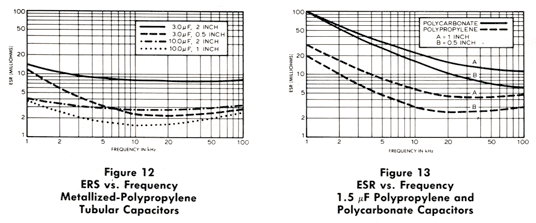
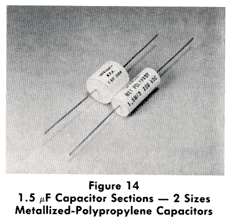
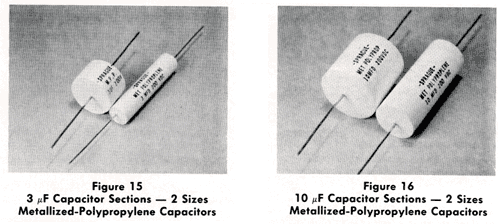
Length and Diameter ESR values measured for 10 µF, 3 µF and 1.5 µF capacitors made with two different film widths show significant improvements in ESR may be obtained by reducing film width. For example, the 3 µF capacitors, each using approximately 760 sq. in. of electrode surface, show a three-fold improvement in ESR for units made with ½ inch wide film as compared to the ESR for units made with 2-inch wide film. The same relationship holds for other units tested. Figures 12 and 13 are plots of ESR vs. frequency for the tested capacitor pairs. Figure 13 also provides ESR data for equivalent metallized-polycarbonate capacitors for reference. Figures 14,15 and 16 show the length to diameter variations for these capacitor pairs. A reduction in film width(requiring an increase in capacitor diameter)is a design consideration where the objective is to minimize the contribution for the electrodes and termination to the total ESR. |
|||||||||||||||||||||||||||||||
|
||||||||||||||||||||||||||||||||
|
Home | About Dearborn | Sales Reps. & Distributors | Technical Documents Capacitor Selection Guide | Capacitor Quick Guide | Power Capacitors New Products | EMI filters | Contact Us | Quote Form |
|
 |
|
|
|
|
|
| Dearborn Electronics, Inc. 1221 N. Highway 17-92 Longwood, FL 32750 |
|
© 1998,1999 Dearborn Electronics, Inc.
Web Site Design by Sales & Marketing
Technologies