
Dearborn Electronics, Inc.


| Energy Discharge Capacitor Dielectrics First, a summary and discussion of the dielectric types used in energy discharge capacitors is in order. There are four important factors when selecting a dielectric. They are: 1) the dielectric constant, 2) the dielectric breakdown voltage, 3) the dielectric’s operating temperature range, and 4) the dielectric’s loss. The first of these directly impacts the size of the final capacitor. The second affects the size and also the capacitor’s reliability or life expectancy. The third determines what dielectrics are appropriate for the application depending on capacitance and voltage rating. The fourth determines the maximum current rating. Table 1 lists the major plastic and paper dielectric types which are considered when designing an energy storage capacitor. Voltage breakdown data was obtained on samples of these dielectrics experimentally and form the manufacturer’s literature. Comparisons can be made between these dielectrics if one assumes that the effect of margins and dielectric thickness, are constant. This comparison is given in Table I. Energy Density Let’s assume that the rated voltage of a capacitor is approximately proportional to the breakdown voltage of the direlectric used. A figure of merit for the maximum energy per cubic inch for a dielectric system can e obtained by multiplying the dielectric constant(k) by the square of the dielectric’s breakdown voltage. See Column 6 of Table I. If the values computed for the maximum rated voltage of a dielectric in Column 6 are divided by the dielectric’s specific gravity or density, a figure of merit for the maximum energy-per-pound can be obtained. See column 7.
|
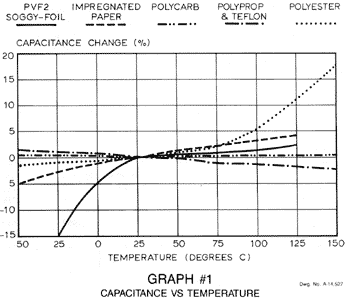
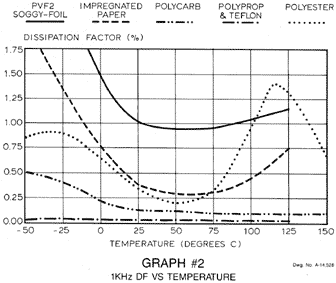
Performance Characteristics The optimum size efficiency is obtained by using plastic film dielectrics, more specifically polyvinylidene difluoride followed by polyethylene terephthalate, hereafter referred to as polyester. Impregnated paper dielectrics have relatively low figures of merit compared to the plastic films. So why aren’t all energy storage capacitors made with these two plastic films? One reason is because polyvinylidene difluoide experiences a dramatic loss of capacitance when the operating temperature drops below zero degrees centigrade. Graph 1 illustrates the effect of temperature on capacitance for dielectric types. This is important when considering the direlectric choice for an energy discharge capacitor, since the available energy in joules equals one-half of the product of the capacitance and the square of the operating voltage. Polyethylene erephthalate, on the other hand, does not have this capacitance loss as a result of temperature, but has another serious drawback. At approximately 85 degrees centigrade it experiences a dramatic increase in dissipation factor. This is a serious shortcoming when designing energy discharge capacitor is directly proportional to the product of the rms current squared ad the resistance. Graph 2 illustrates the effect of temperature on the dissipation factor at a frequency of the one kilohertz. E = ½ (CV2) Polycarbonate, which has a similar dielectric constant to polyester and superior dissipation factor performance over a broader temperature range, ahs the disadvantage of the lowest breakdown voltage. The major disadvantage of polypropylene is its comparably low dielectric constant which limits energy density. Polyphenylene sulfide (PPS), relatively new on the scene of film capacitor dielectrics, may offer advantages of high operating temperatures similar to Teflon (PTFE) but with superior size efficiency, resulting from its higher dielectric constant and breakdown voltage. |
|
Home | About Dearborn | Sales Reps. & Distributors | Technical Documents Capacitor Selection Guide | Capacitor Quick Guide | Power Capacitors New Products | EMI filters | Contact Us | Quote Form |
|
 |
|
|
|
|
|
| Dearborn Electronics, Inc. 1221 N. Highway 17-92 Longwood, FL 32750 |
|
© 1998,1999 Dearborn Electronics, Inc.
Web Site Design by Sales & Marketing
Technologies