
Dearborn Electronics, Inc.


| ENERGY DISCHARGE CAPACITOR DESIGN CONSIDERATIONS Unlike conventional DC capacitors which are used at a steady DC voltage in filtering, by-pass and like applications, energy discharge capacitors are designed specifically for applications which involve varying period so intermittent duty or on/off cycles between charging and discharging. This intermittent use permits the capacitor to be designed for operation at a higher dielectric stress in volts per mil than would be advisable for steady state DC operations. This gives the energy discharge capacitor a size advantage at ht same voltage rating compared to steady state designs. Still, the design must be robust enough to withstand the repeated current pulse on discharge. Current Stress The ability to reduce size and achieve high energy density results in a high peak current stress on the capacitor end connection, in terms of amps per linear inch of active dielectric. If the current stress of the application is severe, the advantage of reduced dielectric thickness to achieve high energy density may be forsaken. The |
length to diameter ratio may also be tailored to achieve an
acceptable amp per linear inch value, if allowed by the application dimensional
requirements. While the limit of the current carrying capability of the metallized energy
discharge capacitor has yet to be determined, values of 0.10 to 0.25 amps per linear inch
have generally been accepted by the industry. This is quite small when compared to several
amperes per linear inch achievable with extended foil designs. In general, the larger the
length to diameter ratio, the greater the joules per cubic inch, but the lower the current
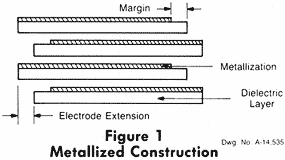
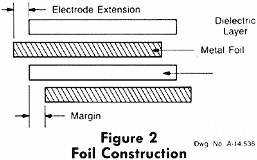
carrying capability. The ultimate current carrying capability is also determined by the type of end connection selected by the designer for the application. There are two basic types. They are: a) metallized extensions of aluminum or zinc layers which have been deposited directly to the dielectric’s surface with thicknesses on the order of hundreds of angstroms (Figure 1), and b) extended discrete metal foils, typically aluminum (figure 2). Each of these have advantages and disadvantages. The choice may not only affect the current carrying capability of the energy storage capacitor but its life, reliability and size. |
|
Home | About Dearborn | Sales Reps. & Distributors | Technical Documents Capacitor Selection Guide | Capacitor Quick Guide | Power Capacitors New Products | EMI filters | Contact Us | Quote Form |
|
 |
|
|
|
|
|
| Dearborn Electronics, Inc. 1221 N. Highway 17-92 Longwood, FL 32750 |
|
© 1998,1999 Dearborn Electronics, Inc.
Web Site Design by Sales & Marketing
Technologies